
Trending
This story is from September 18, 2023
Ganesh idol-makers, low on profits, bank on tradition
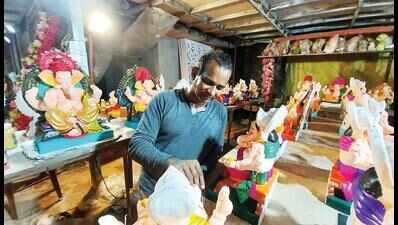
The cost of a clay Ganesh idol can be 1,000 upwards depending on the artwork. The costs of ‘sarvajanik’ idols start at more than 10,000
A member of the community of Chari artisans, from the Char-Rasta of Canacona, said clay idols do not fetch any significant profit because the raw material is expensive.

Another member of the Chari community said that since workers skilled in the craft are scarce, they come at a premium, which further erodes profits. He said it is challenging to preserve the idol-making heritage but the faith in Lord Ganesh keeps him and other artisans going.
The cost of a clay Ganesh idol can be Rs 1,000 upwards
depending on the artwork. The costs of ‘sarvajanik’ idols (those meant for public places) start at more than Rs 10,000 depending on the size and artwork.
As for buyers, most artisans in the state have their own list of customers, usually spanning generations.
Some artisans have inherited the tradition and they sustain it not for money but to respect a legacy. Nothing makes them happier than to cherish the knowledge that their idols are worshipped during Ganesh Chaturthi, popularly known as Chavath, the most widely celebrated festival of Goa.
Manoj Prabhugaonkar, an artisan, said he has been making clay idols for at least three decades. He said he brings clay from Sawantwadi to uphold the art of his forefathers. Prabhugaonkar said, “If someone wants to celebrate Chavath but has no money to buy an idol, I will give one free.”
The festival bonds not only families but a whole population. For example, Tudal is a small hamlet of Gaondongrim in Canacona taluka and is home to eight families. All these families get together every year to celebrate Ganesh Chaturthi for three days
While piety is the same across Goa, some observa-nces are unique. A case in point involves the 13 families of the Prabhugaonkar clan in Poinguinim. The clan worships Lord Ganesh represented as a paper image.
The clan members venture into the nearby forest a day before Ganesh Chaturthi and collect wild leaves — mostly medicinal — and flowers. The ‘puddi’ or bundle of medicinal leaves, wrapped in kasal leaves, is placed before Lord Ganesh’s image.
For legions of other Goans, Chaturthi brings about a reunion of kin. Take for instance the Handekars, one of the most prominent families of Agonda. At least 100 members of the family’s 11th generation, living across the world, unite at the biggest house at Agonda village to take part in the arti ritual.
End of Article
FOLLOW US ON SOCIAL MEDIA










Photostories

Hot Picks
TOP TRENDING
Popular Categories
Hot on the Web
Top Trends
Russell WilsonsMohammed ShamiTom BradyRishabh PantShantanu NaiduUGC NET ResultNobel Peace PrizeMahadev Betting AppNew UPI Transaction LimitRatan Tata DiesCBSE Class 10 12 Practical ExamPopular Schools in Navi MumbaiManagement Colleges of IndiaTop Medical Colleges of IndiaTop Engineering Colleges of IndiaTop Pharmacy Colleges of IndiaLive Cricket Score
Trending Topics
Diwali WishesDussehra 2024 QuotesDussehra WishesVettaiyan OTT ReleaseVettaiyan CollectionVettaiyan ReviewNatasa StankovicDevara CollectionBigg Boss 18Deepika PadukoneShraddha KapoorRatan Tata Passed AwayJigra Movie ReviewVettaiyan Movie ReviewSwatantrya Veer SavarkarDussehra 2024Elon MuskDussehra Whatsapp StatusUltimate Football Codes October 2024Wordle Answer
Living and entertainment
Latest News
Internship scheme: 193 companies post over 90,000 slots on portalApplications for new power connections among services moved exclusively onlineInfosys to no longer send job offer letters and attachments, the company will ...Sara Arfeen Khan opens up about converting to Islam; says, 'I read all holy books and attended a lot of religious debates before converting'Amitabh Bachchan, Rambha, Khushboo and others check in on Govinda after gun misfire incident - ExclusiveCops on unusual hunt: For denturesDiscover 8 animals that suck blood for survivalHappy Dussehra 2024: Top 50 Wishes, Messages, Images and Quotes to Share with Your Loved OnesFortified-food plan faces questions from two PM panel membersCould Tyreek Hill Return to the Chiefs? Cryptic Posts Fuel Trade SpeculationWith special access card, disabled people can skip Exposition queuesForex reserves drop $3.7 billion in week, most since start of AugustAshton Kutcher and Mila Kunis consider leaving Hollywood amid Sean 'Diddy’ Combs' arrest fallout: ReportHow Green is your car?Robert Gronkowski Reacts to His Hilarious Impression in FX's American Sports Story: Aaron HernandezIf Rahul Gandhi fails to deliver, INDIA bloc may make LoP post rotational: BJP‘Kallanum Bhagavathiyum’: The Vishnu Unnikrishnan and Mokksha starrer is set to get a sequelAlia Bhatt, Bipasha Basu, Rhea Chakraborty and others seek blessings at Kajol and Rani Mukerji's Durga Puja pandal - See photos
Copyright © 2024 Bennett, Coleman & Co. Ltd. All rights reserved. For reprint rights: Times Syndication Service